Controlled AI
Rules-Based Chatbot or AI Replies? When to Use Each—and When to Combine Them
Choose fixed steps, AI replies or a hybrid by comparing the same four customer requests, then define the sources, action boundaries and evidence each path needs.

A qualitative design guide using a fictional business. Examples are proposed designs, not measured benchmarks or observed customer results. All worksheet cases start as NOT_RUN.
A customer writes, “Tuesday afternoon works.” Should your chatbot ask another question, offer appointment times, or confirm a booking? The right answer depends on what has happened in the conversation and in your booking system.
Choosing a rules-based chatbot vs an AI chatbot becomes easier when you separate those jobs. Fixed steps control a defined path. AI replies help interpret varied questions and explain approved information. A hybrid workflow combines conversation with explicit conditions and actions.
Use the comparison below to choose a path for four common requests. Download the decision worksheet to record your own sources, boundaries, and tests. Its examples are proposed designs; every result starts as NOT_RUN.
Separate an answer from an action
Write down what the customer should receive and what, if anything, must change elsewhere.
“We open at 9 AM” is an answer. “What day suits you?” collects information. Creating a calendar event is an action. “Your appointment is confirmed” is a commitment that needs evidence from the reservation system. Whether the customer received that confirmation is a further delivery check.
Keep four observations separate: the reply generated, the action attempted, the action's confirmed result, and the message's delivery. A well-written reply does not establish the other three.
For this guide:
- Rules-based means configured messages, questions, conditions, and branches determine the path. The design must account for the inputs it accepts and where unmatched inputs go.
- AI replies means a model interprets or generates conversational text using its instructions and available information. Understanding a preferred day does not reserve it.
- Hybrid means AI handles part of the conversation while explicit steps determine required fields, routing, and external actions.
Fixed wording can contain outdated hours. AI can answer from an incomplete source. Choosing either approach still leaves your team responsible for the information and the path when something is missing.
Compare rules, AI, and hybrid paths on the same requests
This is a qualitative design aid, not a measured benchmark. The examples use a fictional design studio that opens Monday–Friday, 9 AM–6 PM, offers consultations, and confirms appointments only after a successful reservation. No exception policy is supplied.
| Customer request | Rules-only approach | AI reply role | Hybrid approach to consider |
|---|---|---|---|
| “Are you open Saturday?” | A clear opening-hours option returns the approved schedule. Unmatched text needs another route. | Answer the question from the current hours source. | Use AI for wording variations; use a fixed route when a relevant exception is missing. |
| “Can you help with my room?” | Offer a short service menu and ask the customer to choose. | Ask which kind of help they need. | Clarify the request, then move to a defined service branch. |
| “Book Tuesday afternoon.” | Collect required details and offer available times through configured booking steps. | Clarify preferences and collect details. | Collect conversationally, then check details and run an explicit reservation step. |
| “Make an exception and refund me.” | Explain the published policy, if available, and route exceptions to a person. | Identify the request and explain the limits of the available information. | Collect enough context for a person; keep approval and any refund action outside the generated reply. |
Choose the simplest path that covers the request and its failure cases. A short menu may be enough for a small, stable set of options. AI can be useful when customers describe the same need in many ways. A hybrid becomes useful when that conversation leads to a controlled action.
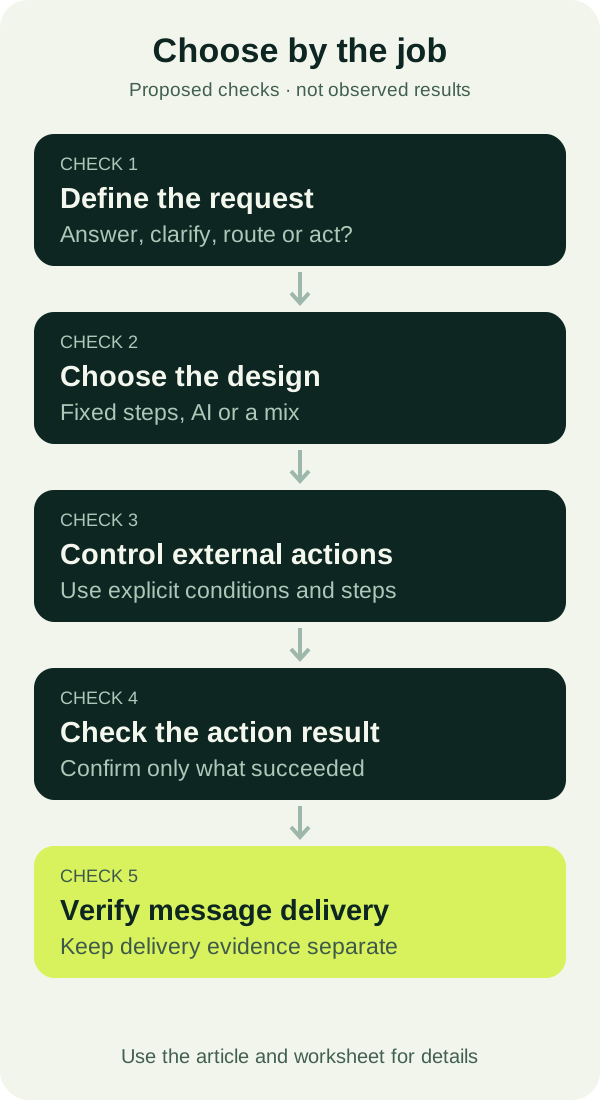
The diagram is a proposed design aid, not an application screenshot or a record of a completed action.
Work through the four decisions
1. A factual FAQ: opening hours
For “Are you open Saturday?”, the sample schedule supports a direct answer: the studio is closed on weekends. A fixed “Opening hours” button can provide that answer without an AI step. It needs a maintained message and a route for questions the menu does not cover.
An AI reply can interpret “r u open sat?” against the same approved schedule. That is a reason to test varied wording, not evidence that every variation will work.
A hybrid can answer the ordinary question and stop when it becomes “What about the next public holiday?” The sample facts contain no holiday schedule. Ask the team to confirm rather than applying normal weekday hours to an exception. Record the exact source used so an old fixed message and a new AI source do not silently disagree.
2. An unclear inquiry: choosing a service
“Can you help with my room?” does not identify a service or authorize an appointment. A rules-only path might ask the customer to choose between styling advice, a consultation, and speaking to the team. Provide an escape route if none fits.
An AI conversation could ask, “Are you looking for styling ideas or help arranging a consultation?” Give the clarification a defined goal. More conversation is not useful if it never reaches a decision.
In a hybrid design, route only after the intended service is clear. If the customer changes their mind, allow a correction before proceeding. If they ask for something outside the supplied service information, use the human route. Choose a clarification limit your team can support; it is a design decision to configure and test, not an assumed product default.
3. A booking request: preference versus reservation
“Book Tuesday afternoon” supplies a preference, not a confirmed slot. A rules-only workflow can collect the service and contact details, then offer times through an explicit booking path. AI can collect those details conversationally. Neither approach should infer availability from the customer's request.
A hybrid design can move from collected details to a controlled sequence: resolve the exact date and timezone, show available choices, obtain the customer's choice, and attempt the reservation. Only a successful action result permits confirmation. Implement these checks in the configured workflow or connected system; do not assume an instruction in a prompt enforces them.
If the reservation fails, say it could not be completed and offer the intended alternative. If the outcome is unknown after a connection problem, check for an existing reservation before trying again. Keep the action reference separate from the outgoing message receipt so your team can investigate either failure.
4. An exception: who can authorize it?
“Make an exception and refund me” needs a decision-maker. The fictional studio has supplied no refund policy, so neither a fixed message nor AI should invent one.
A fixed path can explain that the team needs to review the request. AI may help clarify what the customer is asking for, but a sympathetic sentence must not become an approval. In a hybrid design, collect only the context the team needs and route it to the intended person or queue. Any later refund requires the appropriate authorization and action result.
Check that a person can find the conversation and knows they own the next response. A message saying “I've passed this on” does not establish that anyone has accepted it. For a practical ownership routine, use the small-team shared-inbox guide.
Set the boundaries before building the conversation
For each row in your worksheet, name the approved source, the fields needed to proceed, the external action allowed, and the condition that stops automation. Define what the customer should hear when a source is missing, a required field is unclear, or an action fails.
Choose a human route for requests beyond those boundaries. Agree what happens when the receiving teammate is unavailable and when automation can resume. These are operating decisions; do not leave them implied by the chatbot's tone.
Hosqi's public AI feature description describes fixed-only workflows and workflows combining fixed steps with AI. It distinguishes AI conversation and detail collection from explicit booking, CRM, and other action steps. This supports the design choice above; it does not demonstrate that a particular configured workflow has passed its tests.
Cost is another question to evaluate separately. The same page states that AI uses plan credits and steps without AI do not use AI credits. That does not mean the entire workflow, channel, or connected service is free. Compare your actual plan and tested usage; this guide contains no measured cost or speed comparison.
Test the decision before activation
Start with the four worksheet requests, then add one nearby failure case for each: missing holiday hours, an unclear service after clarification, a failed reservation, and a request for an unauthorized exception.
Record the workflow revision, source revision, exact input, actual reply, action result, final human route, and permitted evidence reference. Leave the result as NOT_RUN until someone performs the check. Treat a false booking confirmation as a release blocker even if the rest of the wording looks good.
Separate the evidence from different test environments. Hosqi's chatbot-builder page describes free private simulation in which AI and connected apps are simulated and nothing is sent externally. That can help inspect branches; it does not measure real-model answer quality or prove a calendar update.
The page also describes an optional preview that uses real AI and displays its credit cost before running, plus live tests with approved testers. A real AI answer still does not prove delivery on a connected channel. Verify the actual message receipt and external action separately before relying on them. No such runtime tests were performed for this article.
Use the 20-question AI support checklist when you need broader coverage of missing information, context, and action failures. Revise the chosen design when a failure shows that it needs another condition, a better source, or an earlier human route.
To start your own comparison, explore Hosqi's chatbot builder and map one customer request in the worksheet. Choose fixed steps, AI, or a combination based on the decisions and evidence that request needs.
Downloads
Editable working files from this article. They contain fictional examples only.
Sources
Hosqi product statements in this article are based on these public pages, read on the dates shown.
About this article
Hosqi is the organizational author of this article. Examples and names in it are fictional unless a source says otherwise.